Saturday, 27 January 2018

Saturday 27th

We set off from the hotel in search of breakfast and found things at reasonable prices at Aunt Maud's just down the street.

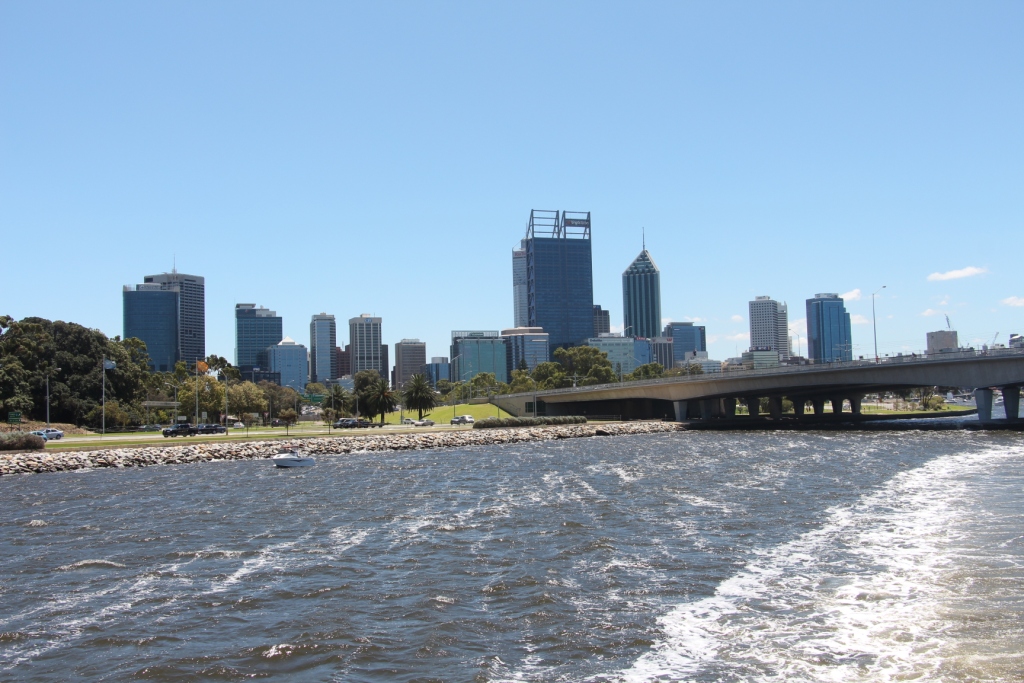
We continued on to the water's edge and walked around the water front there.  It's a very attractive environment.  We decided to take a boat somewhere and we plumped for the return cruise along the Swan River to Fremantle.

And what a great trip it turned out to be.


Supreme Court of Western Australia

You've "herd" of Sheffield, so this must be "pod" of Perth!

And very soon the alarm bells are ringing ....


Think they were making a promotional video


No, it isn't Venice!


So we set off on our 75-minute trip downstream to the port of Fremantle ....


The land for this Italianate property was bought in the late 1950s for around £1800. The owner has developed it into around a dozen individual units of habitation, one for each of his children.  The trouble is, they told him they don't like the idea of living so close together!


This property was recently sold for around £35 million


And we finally arrived ....

Around 10 hours and 20 minutes after leaving Abu Dhabi, we touched down at Perth Airport in the early afternoon.  With a temperature of 32C and a cloudless sky, it was quite a contrast from what we'd left behind ....


Was this day light or moonlight? No, just Boeing's idea of what we might like coming in the window instead of sunlight!

Upper reaches of the Swan River

We got through immigration and customs without delay. Everyone is friendly and helpful and off we went to the luggage carousel.  We soon got Graeme's case off the belt and then there was a lull.  Bags disappeared and we found ourselves almost alone. Then Elizabeth's name was called out over the PA.  Yes, her case was still at Manchester Airport! They told us to expect it on the next day's flight and that reasonable expenses for clothing in the meantime would be reimbursed.

So, after a quick pit stop at the hotel off we went clothes shopping - on a public holiday when shops here are generally closed.  Here's Elizabeth posing with a couple of potential new outfits ....


This bar opposite our hotel had England losing to Australia in the 4th ODI of the series on the TV.  It's free-to-view in Australia! But don't down those beers too quickly - a pint and a half cost £9.25!

Perth Waterfront


Perth's 'Skyworks' to celebrate Australia Day


This bridge was NOT sponsored by McDonald's!


Thursday, 25 January 2018

The Latest Adventure Begins

And today has gone just like that because, as we start our approach to Abu Dhabi Airport, the sun is already setting.


Our home for a few hours until the next leg ....
Then we were off again from Abu Dhabi to Perth - just over 10 hours on an overnight run - 


You can tell that the plane's destination is Australia as the onboard flight entertainment includes the local sports!


Tuesday, 23 January 2018

Wednesday, 10 January 2018

Cruise Day 3: Doubtful Sound

Doubtful Sound / Patea is a very large and naturally imposing fiord which takes second place after Milford Sound as New Zealand's most famous tourism destination.

At 42 kilometres (26 mi) long, Doubtful Sound is the longest, and with a depth of up to 421 metres (1,381 ft) also the deepest of the South Island's fiords.  In comparison with Milford Sound, it is more widespread, with the cliffs not as dramatically tall and near vertical.


Like most of Fiordland, Doubtful Sound receives a high amount of rainfall, ranging from an annual average of 3 to 6 metres (10 to 20 feet).  The vegetation on the mountainous landscape surrounding the fiord is dense native rainforest.

Doubtful  Sound was named 'Doubtful Harbour' in 1770 by Captain Cook, who did not enter the inlet as he was uncertain whether it was navigable under sail.  It was later renamed Doubtful Sound by whalers and sealers.


Doubtful Sound on a clear day
Doubtful Sound lies deep within the Fiordland National Park, about 50 kilometres (31 miles) from the nearest inhabited place, the small town of Manapouri, and is surrounded by mountainous terrain with peaks typically reaching 1,300–1,600 metres (4,300–5,200 ft). Along the coast, there are no settlements for about 200 kilometres (120 miles) in either direction.


Charles Lyttleton, Governor-General of New Zealand (1957-1962) wrote about this part of Fiordland:

"There are just a few areas left in the world where no human has ever set foot. That one of them should be in a country so civilized and so advanced as New Zealand may seem incredible, unless one has visited the south-west corner of the South Island. Jagged razor backed mountains rear their heads into the sky. More than 200 days of rain a year ensure not a tree branch is left bare and brown, moss and epiphytes drape every nook. The forest is intensely green. This is big country... one day peaceful, a study in green and blue, the next melancholy and misty, with low cloud veiling the tops... an awesome place, with its granite precipices, its hanging valleys, its earthquake faults and its thundering cascades."

Doubtful Sound (like many of the fiords in the area) is unusual in that it contains two distinct layers of water that scarcely mix. Depending on rainfall the night before, the top 2–10 metres (5ft – 35 ft) is fresh water, fed from the high inflows from the surrounding mountains, and stained brown with tannins from the forest. Below this and partially insulated by the fresh water above is a layer of warmer, heavy, saline water from the sea. The dark tannins in the fresh water layer make it difficult for light to penetrate. Thus, many deep-sea species grow in the comparatively shallow depths of the Sound.  Such species include black coral, which is normally found at depths of 30–40 metres (100–130 ft) but can be found at just 10 metres (35 ft) in Doubtful Sound.


Doubtful Sound on a typical day!
The catchment basin of Doubtful Sound is generally steep terrain that is heavily forested except for locations where surface rock exposures are extensive.

As well as bottlenose dolphins, fur seals, penguins, right whales and humpback whales, the fiord is also home to minke whales, sperm whales and even giant beaked whales.  Orcas (killer whales) and long-finned pilot whales can be found too.

The sound has been identified as an Important Bird Area by Birdlife International because it's a breeding site for Fiordland Penguins.  Secretary Island and Bauza Island are some of the most important sanctuaries in New Zealand for critically endangered birds.

Cruise Day 3: Milford Sound

Milford Sound is a fiord in the southwest of New Zealand’s South Island.  It’s known for towering Mitre Peak, plus rainforests and waterfalls like Stirling and Bowen falls, which plummet down its sheer sides. The fiord is home to fur seal colonies, penguins and dolphins.  It has been judged the world's top travel destination in an international survey (the 2008 Travelers' Choice Destinations Awards by TripAdvisor) and is acclaimed as New Zealand's most famous tourist destination.  Rudyard Kipling had previously called it the eighth wonder of the world.


Mitre Peak on Milford Sound
Milford Sound is named after Milford Haven in Wales.  The Māori named the sound Piopiotahi after the thrush-like piopio bird, now extinct.  The Sound runs 15 kilometres inland from the Tasman Sea and is surrounded by sheer rock faces that rise 1,200 metres (3,900 ft) or more on either side. Among the peaks are The Elephant at 1,517 metres (4,977 ft) and The Lion, 1,302 metres (4,272 ft).

Milford Sound sports two permanent waterfalls, Lady Bowen Falls and Stirling Falls.  After heavy rain temporary waterfalls can be seen running down the steep sided rock faces that line the fiord and on rainy and stormy days tourists can admire the play of the wind with the numerous waterfalls in Milford Sound. When meeting the cliff face the powerful wind often goes upward and waterfalls with a vertical drop get caught by wind, causing the water to go upwards.

The 151 metre (495 ft) Stirling Falls were named after Frederick Stirling, Captain of the HMS Clio.
With a mean annual rainfall of 6,412 mm (252 in) each year, a high level even for the west coast, Milford Sound is known as the wettest inhabited place in New Zealand and one of the wettest in the world.  Rainfall can reach 250 mm (10 inches) during a span of 24 hours.

Seals, penguins and bottlenose dolphins frequent the waters, and whales, especially humpback whales and southern right whales are increasingly observed due to recoveries of each species.

Milford Sound was initially overlooked by European explorers, because its narrow entry did not appear to lead into such large interior bays.  Sailing ship captains such as James Cook, who bypassed Milford Sound on his journeys for just this reason, also feared venturing too close to the steep mountainsides, afraid that wind conditions would prevent escape.

Milford Sound attracts between 550,000 and 1 million visitors per year.  This makes the sound one of New Zealand's most-visited tourist spots even with its remote location and long journey times from the nearest population centres.

Cruise Day 3 - Fiordland

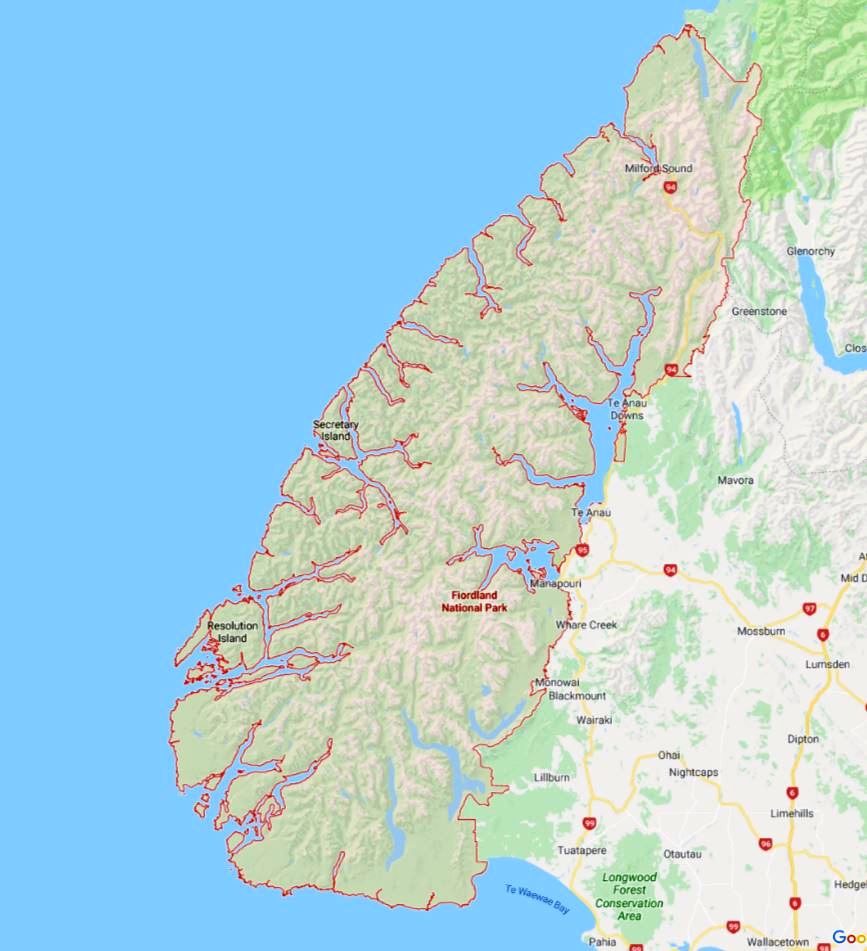
Fiordland is in the south-western corner of New Zealand's South Island.  Most of Fiordland is dominated by the steep sides of the snow-capped Southern Alps, deep lakes, and its steep, glacier-carved and now ocean-flooded western valleys.  The Fiordland National Park is New Zealand's largest National Park.
Fiordland is in the south-west corner of New Zealand
Twelve fiords, some stretching up to 40 kilometres (25 miles) inland, and two inlets leading to three more fiords, extend along the coast from Milford Sound in the north to Preservation Inlet in the south.  In general, the fjords become wider from north to south as the height of the mountains decreases.

Due to the often steep terrain and high amount of rainfall supporting dense vegetation, the interior of the Fiordland region is largely inaccessible.  The fiords are typically named 'sounds' even though geologically they are not.  Of the twelve major fiords on Fiordland's west coast, Milford Sound is the most famous and the only one accessible by road.  Doubtful Sound is much larger and is also a tourist destination, but is less accessible.

Also situated within Fiordland are Browne Falls and Sutherland Falls, which rank among the tallest waterfalls in the world, and New Zealand's three deepest lakes, Lake Hauroko, Lake Manapouri, and Lake Te Anau.

This part of New Zealand, especially to the west of the mountain divide of the Southern Alps, has a very wet climate with annual average of 200 rainy days and annual rainfall varying from 1,200 millimetres (47 inches or nearly 4 feet) in Te Anau to 8,000 millimetres (310 inches or over 25 feet) in Milford Sound.  The prevailing westerly winds blow moist air from the Tasman Sea onto the mountains, resulting in high amounts of precipitation as the air rises and cools down.


The tallest mountain in the Fiordland region is Mount Tutoko at 2,723 metres (8,934 ft), one of several peaks over 2,000 metres in the Darren Mountains.  South-east of this area, there are only a handful of peaks reaching 2,000 metres, however due to the rainy weather with cold winters and lack of hot summer temperatures, even these mountains contain glaciers and peaks with permanent snow cover.

Sunday, 7 January 2018

Overnight Pre-cruise Stop: Sydney

Sydney, capital of New South Wales and one of Australia's largest cities, is best known for its harbour front Sydney Opera House, with a distinctive sail-like design. Massive Darling Harbour and the smaller Circular Quay port are hubs of waterside life, with the arched Harbour Bridge and esteemed Royal Botanic Garden nearby.

Lightning over Sydney
Sydney Tower’s outdoor platform, the Skywalk, offers 360-degree views of the city and suburbs.  Located on Australia's east coast, the metropolis surrounds the world's largest natural harbour and sprawls about 43 miles on its periphery towards the Blue Mountains to the west, Hawkesbury to the north and Macarther to the south.

Saturday, 6 January 2018

Our First Stop: Perth

Perth, capital of Western Australia, sits where the Swan River meets the southwest coast. Sandy beaches line its suburbs, and the huge, riverside Kings Park and Botanic Garden on Mt. Eliza offer sweeping views of the city. The Perth Cultural Centre houses the state ballet and opera companies, and occupies its own central precinct, including a theatre, art galleries and the Western Australian Museum.

Perth skyline
Isolation
Perth is one of the most isolated major cities in the world. The nearest city with a population of more than 100,000 is Adelaide, 1,324 miles away. Only Honolulu (population 374,660), 2,387 miles from San Francisco, is more isolated.

Perth is geographically closer to both Dili, East Timor (1,731 miles), and Jakarta, Indonesia (1,865 miles), than to Sydney (2,045 miles), Brisbane (2,239 miles), or Canberra (1,930 miles).

Demographics
Perth is Australia's fourth-most-populous city, having overtaken Adelaide's 's population in 1984.  In June 2016 there were an estimated 2,022,044 residents in the Greater Perth area, representing a population increase of approximately 1.0% from the 2015 estimated population of 2,002,114.